
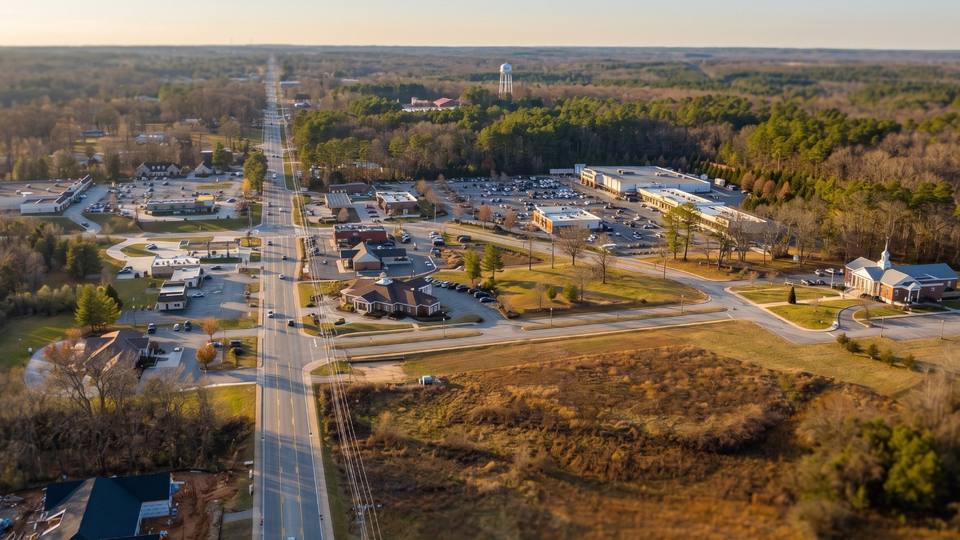
This town has been called Christiana, Jingo and Fairview, and it took until 1937 to settle on the last one. Before any of those, the first post office in the district was called Barren. A place that keeps changing its name is a place that keeps having to decide what it is, and the history of Fairview is largely the history of those decisions — most of them made by very small numbers of people, several of them made badly, and one of them made by a farmer who wanted to go home.
Fairview is a young city on old ground. It incorporated on July 28, 1959, which makes the city younger than plenty of people currently living in it. The ground is a great deal older.
The road came first
Before there was a town there was a route. Native people lived in this country first, among them Cherokee, Chickasaw, Choctaw, Creek and Shawnee. The Natchez Trace, the old trail they and later travelers used, runs a few miles from where the town now sits. White settlers arrived at the end of the 1790s, and what they built first was what travelers needed.
Around 1809 somebody put up a tavern near the headwaters of Brush Creek, on the road between Franklin and Charlotte. It was called Horn Tavern for its sign: animals painted either side of the door, crowned with horns from elk, deer, ram, buffalo and oxen. The marker there says the sign is the reason the tavern was reportedly spared from burning during an attack, which is either a good story or a good sign, and possibly both.
Iron, and who did the work
By 1832 Moses Speer had a furnace going on two thousand acres near Caney Fork creek. It sat at the eastern end of a trade that ran the length of the Western Highland Rim, with 33 furnaces in blast by 1847.
The marker at the site is plain about the labor, and it is worth not skipping: skilled and unskilled hands, enslaved people among them, working under an ironmaster. Speer's operation failed, the property changed hands, and the furnace was cold by 1848. The stone stack is still standing on Caney Fork Road, on the National Register of Historic Places, the only piece of that industry left anywhere in Williamson County.
By Jingo
The district's first post office, Barren, opened in September 1839. A later one was called Christiana. In 1880 a committee of citizens sat down to rename it and could not agree, and one farmer eventually ended the meeting with the sentence this town lived under for the next fifty-seven years: "It's late. If you can't decide, By Jingo, I'm going home."
Jingo it was.
The town that never happened
In 1889 a Franklin lawyer named P.E. Cox and a partner, N.E. Morris, tried something ambitious on part of a 4,000-acre land grant: a planned town called Pasadena, laid out over 1,391 acres of square blocks, avenues, parks and a town square. It got as far as a hotel, a school, a post office, a blacksmith, a doctor's office and a tobacco warehouse. Then it failed.
The conversation
No comments yet