Bowie Nature Park has been protected since 2008 by a permanent conservation easement held by The Land Trust for Tennessee. The recorded document is public, and it spells out what can be built, what can't, and who has to agree before anything changes.
A question posted in a Fairview Facebook group on Sept. 30 drew more than 20 replies within a few hours: Who is trying to get rid of the park trust, and why?
The "trust" is the legal protection on Bowie Nature Park. The Fairviewian found no proposal before the city to remove or change the park's protections. The document behind all of this is public. Here is what it says.
It started as a gift
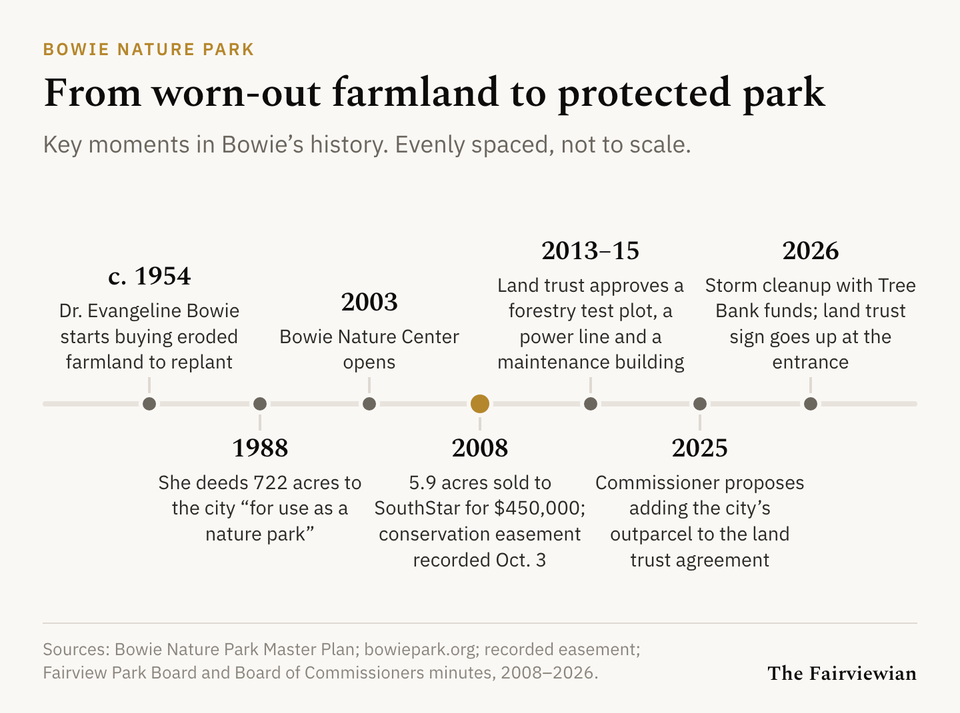
Key moments in Bowie Nature Park's history.The Fairviewian
Beginning around 1954, Dr. Evangeline Bowie began buying land in Fairview that had been stripped bare by farming. In places, gullies were carrying off 20 to 30 tons of topsoil a year, according to the city's Bowie Nature Park Master Plan. She filled gullies, terraced, built dams and planted more than 500,000 loblolly pines, according to the park's history page. Residents often speak of "the Bowie sisters": Friends of Bowie Nature Park says she did the work "with the help of her two sisters, Anna and Byrd."
On Dec. 22, 1988, Dr. Bowie deeded the land to the City of Fairview "for use as a nature park." The gift totaled 722 acres, according to the master plan.
The deed came with conditions of its own, known as the Bowie Deed Restrictions. They are quoted in full in the , and they still apply. The city must use the land as a wildlife preserve and/or park, and its leaders are to be guided by "Dr. Bowie's preference that the ecology of the Property be preserved as much as is possible." Hunting is banned. Firearms (except by law enforcement) and fireworks are prohibited, and alcohol requires specific approval. The city may make reasonable improvements and may build municipal buildings, such as a fire station or city hall, in areas that don't detract from the park.
Share this story
The conversation
No comments yet
Comments come with a name attached, so you need an account to leave one. Reading them takes nothing.
The deed also lets the city sell any portion of the land that would not diminish its use as a preserve or park, as long as the money is reinvested in the park. That is why part of the original gift is now commercial property. In 2008 the city sold 5.9 acres to SouthStar, creating a park fund, according to Park Board minutes from March 3, 2014, which put the sale price at $450,000. The master plan says that land is now the Bowie Commons shopping area.
Then came the conservation easement
In October 2008, the city placed most of the park under a conservation easement held by The Land Trust for Tennessee, a Nashville-based nonprofit. That easement is the "land trust" people are talking about. It was recorded with the Williamson County Register of Deeds on Oct. 3, 2008, at Book 4652, pages 741 to 775, and the full 35-page document is posted on the park's website.
The city still owns the park. An easement doesn't transfer ownership. It permanently gives up certain rights, chiefly the right to develop the land, and gives a nonprofit the job of enforcing those limits. The document recites that the land trust paid nothing for it.
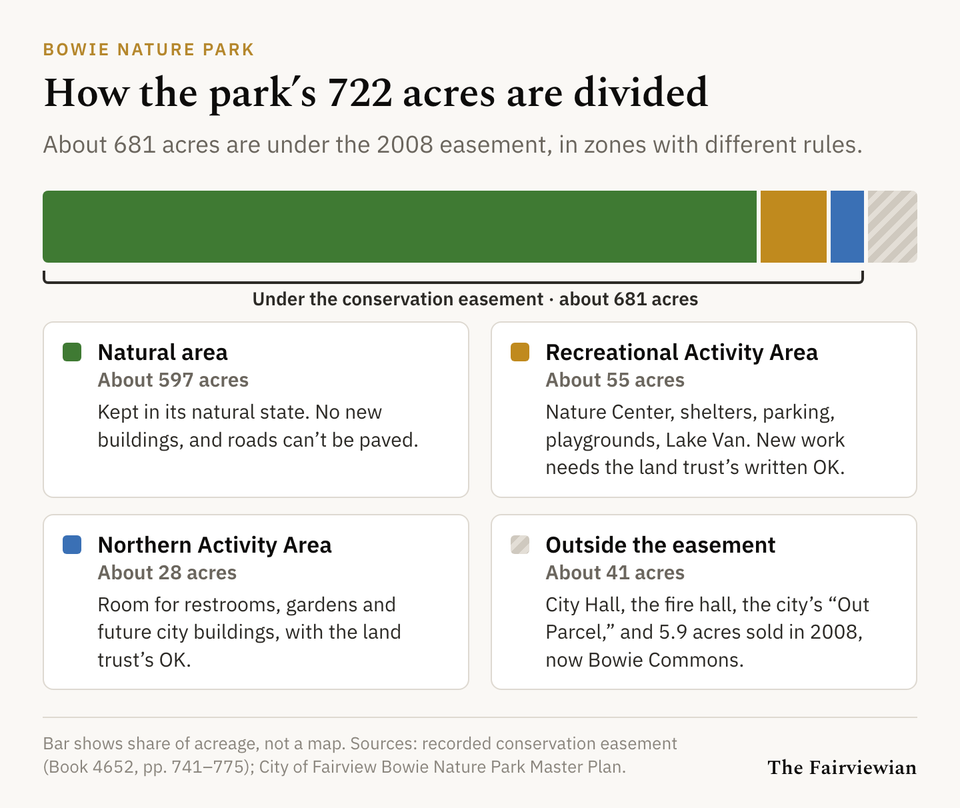
It covers about 681 of the park's roughly 722 acres. According to the master plan, the rest went to City Hall, the fire hall and community service building, a city "Out Parcel," and the tract sold for Bowie Commons.
How Bowie's acreage is divided under the 2008 conservation easement.The Fairviewian
What the easement allows, and what it doesn't
The easement doesn't freeze the park as it is. It sets up zones.
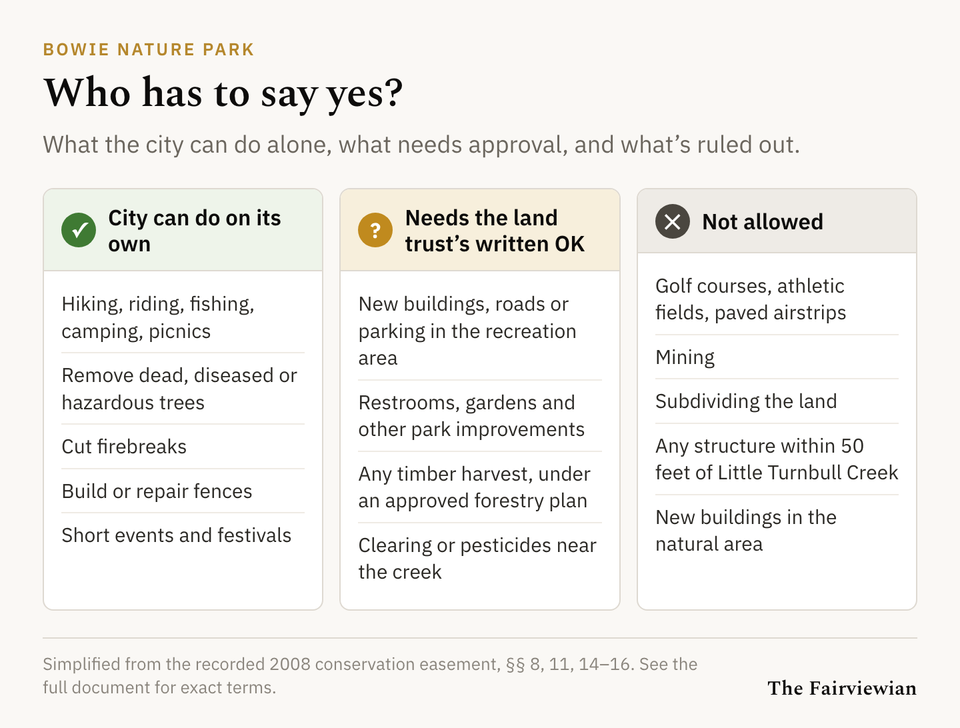
Outside two designated "activity areas," the land "is to be maintained in its natural state." No new structures are allowed there except as the easement provides, and roads can't be paved. Across the whole property, the easement prohibits golf courses, athletic fields, paved airstrips, mining and further subdivision. It extinguishes the land's development rights and bars any structure within 50 feet of the banks of Little Turnbull Creek and its tributaries. It specifically allows low-impact additions such as trails, bridges, benches, informational kiosks and picnic shelters.
The two activity areas total roughly 84 acres. In the Recreational Activity Area (about 55 acres), roadways, parking, nature center buildings, picnic shelters, horse areas, trails, playgrounds and fishing areas on Lake Van may be built or expanded, with the land trust's prior written consent. The Northern Activity Area (about 28 acres) includes a "Future Park Improvement Area" of about 14 acres. There, nature-park improvements, including restrooms, gardens and water features, are allowed with the land trust's written consent "in Grantee's sole discretion." The Northern Activity Area also includes about 10 acres set aside for future municipal buildings.
Special events and festivals are allowed, including temporary stages, parking, toilets and food sales, as long as they are not "irremediably destructive" of the park's conservation values. The city keeps the right to use the park for camping, fishing, hiking, horseback riding, picnics, social events and educational programs.
Timber is covered too. Any forestry has to follow a plan that is "reasonably satisfactory" to the land trust, and areas of mature hardwoods are to be protected.
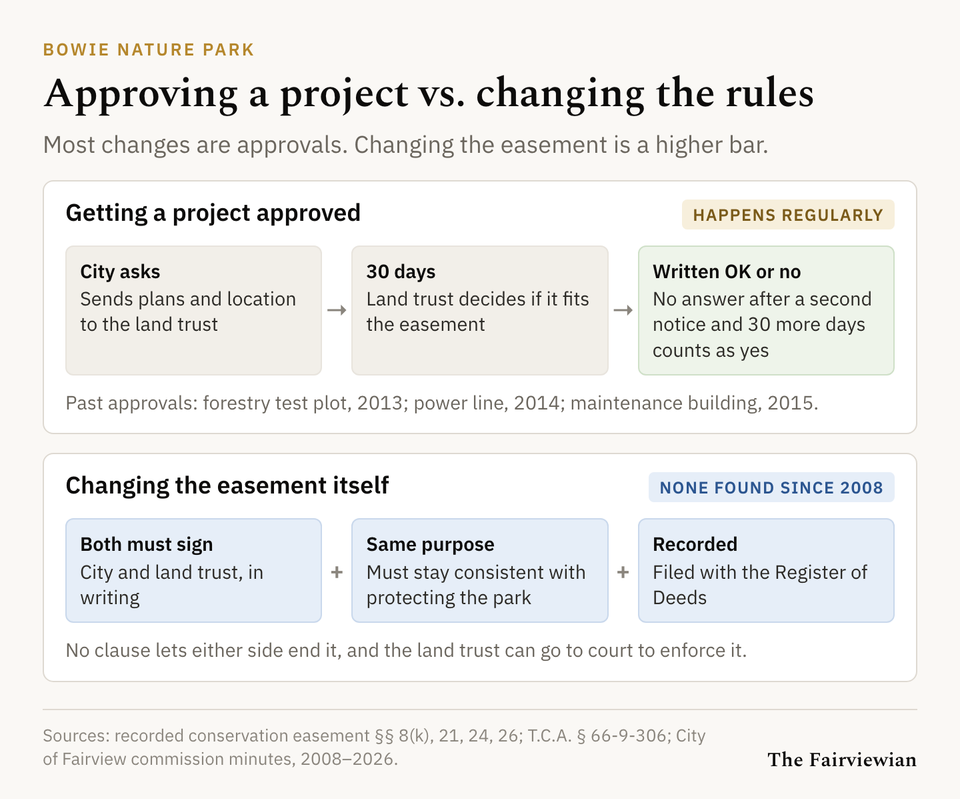
So when people say an idea needs the land trust's approval, that is usually what they mean. Many improvements are allowed, but the city has to ask first. The easement gives the land trust 30 days to answer a request once it has the paperwork. If it doesn't, the city can send a second notice, and if that also goes unanswered for 30 days, consent is treated as given.
What the easement allows, simplified from the recorded document.The Fairviewian
Could the city get rid of it?
Not on its own.
The easement says it "may be amended only with the written consent of Grantee and Grantor," meaning both the land trust and the city, and that any amendment "shall be consistent with the purposes" of the easement. It grants the protections "in perpetuity" and contains no clause allowing either side to end it. If the city violates it, the land trust can go to court for an injunction and an order to restore the land.
Tennessee law points the same way. Under the state's Conservation Easement Act of 1981, an easement "shall remain severed from the fee unless returned by specific conveyance to the holder of the fee" (T.C.A. § 66-9-304). No easement is "automatically extinguished because of violation of its terms or frustration of its purposes" (§ 66-9-306).
The Land Trust for Tennessee is accredited by the Land Trust Accreditation Commission. The national standards that accreditation is based on say an amendment should "have a net beneficial or neutral effect" on the protected conservation values. They say ending an easement should happen only "in the rare case that it is necessary," with "judicial or regulatory review when required by law."
The easement names one exception, carried over from the original deed. If the park were ever conveyed to the State of Tennessee, the deed restrictions would end, and so would the easement unless the state expressly accepted it. Nothing in public records suggests any such transfer has been proposed.
The Fairviewian reviewed every set of city commission, park board and tree commission minutes the city has posted since 2008 and found no vote to amend the easement. What the minutes show instead is the land trust approving individual projects under it: a forestry test plot in 2013, a power line through the park in 2014, and a maintenance building in 2015, which the land trust approved by letter as "a permitted use." In 2015 it also turned down a forestry plan it found insufficient.
The one proposed change would add land rather than remove it. The city's Bowie "outparcel" was part of Dr. Bowie's gift but was left out of the easement in 2008, according to minutes from June 17, 2008. In April 2025, Commissioner Carolyn Roberts proposed adding it to the land trust agreement and told the board the land trust had a hold on new requests, according to the April 17, 2025 minutes.
Approving a project vs. changing the easement.The Fairviewian
What the park brings in, and what it costs
Several residents asked how much money Bowie makes. The trails are free for hikers. Riders pay $2 a day per bike or per horse, and Fairview residents and the 37062 ZIP code are exempt, according to the park's trail page. The two picnic shelters rent for $20 to $60 depending on length and residency, according to the shelter reservation form. The city code (§ 20-501) sets the Nature Center at $50 an hour with a $500 deposit.
The Parks Department's general-fund budget for this fiscal year is $870,126. That covers the whole park system, including Veterans Park and the Historical Village, not just Bowie.
Friends of Bowie Nature Park, a volunteer group that first met in 1994, does volunteer work in the park under an agreement the Board of Commissioners approved 4-0 on Aug. 21, 2025, according to the meeting minutes.
What else has come up recently
On April 8, 2026, the Board of Commissioners voted 5-0 to use Tree Bank funds for debris cleanup, removal of dead or hazardous trees, and replanting at Bowie Nature Park after Winter Storm Fern. The park cleanup was estimated at about $150,000, according to the meeting minutes.
In February 2025, commissioners debated a proposed police training facility next to the park. Several asked staff to look at other locations, according to the Feb. 6, 2025 minutes.
The outparcel came up again on Dec. 4, 2025. Vice Mayor Chris McDonald proposed using 10 acres of a city outparcel for a botanical garden funded through the Tree Bank account. Commissioner Carolyn Roberts said she would prefer to see the outparcel placed into a land trust, and Commissioner Wayne Hall voiced support for that idea, according to the meeting minutes. That would add protection to more city land; it would not remove any from Bowie.
Read it yourself
The full recorded easement is posted at bowiepark.org. The Land Trust for Tennessee can be reached at 615-244-5263.
The Fairviewian is inviting every candidate for mayor and city commission to answer the same questions, including where they stand on Bowie Nature Park and the easement. Responses will be published in the candidates' own words before early voting begins Oct. 14.
About this story
This story was already in progress when residents began asking about the park's protections, and those questions prompted The Fairviewian to publish it now.
The Fairviewian's review of the easement covered the recorded document and the city meeting minutes posted since 2008. It did not include a search of Williamson County deed records, which would show any amendment filed with the Register of Deeds, and The Land Trust for Tennessee had not been asked to comment at publication. This story will be updated with anything either turns up.

The conversation
No comments yet